About Insomnia
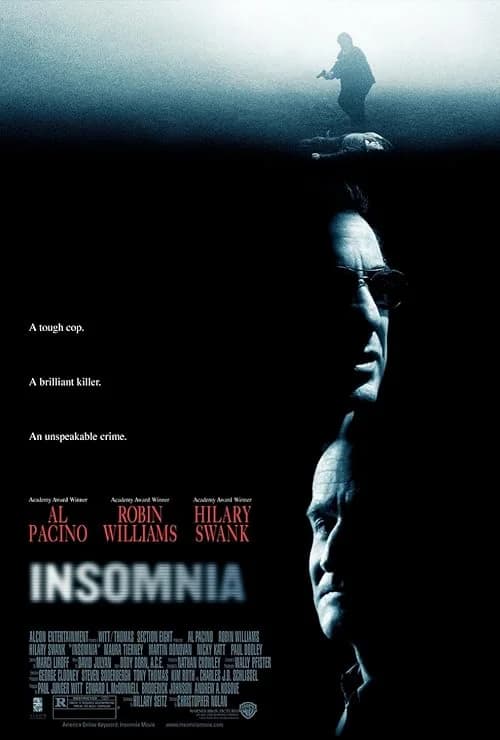
Christopher Nolan's 2002 psychological thriller Insomnia presents a gripping cat-and-mouse game set against the haunting backdrop of perpetual Alaskan daylight. The film follows veteran LAPD detective Will Dormer (Al Pacino), who travels to a remote Alaskan town to investigate the murder of a teenage girl. As Dormer and his partner Hap Eckhart (Martin Donovan) close in on prime suspect Walter Finch (Robin Williams), a tragic fog-shrouded accident leaves Dormer morally compromised and battling severe insomnia in the land of the midnight sun.
Al Pacino delivers a masterful performance as the sleep-deprived detective whose judgment deteriorates as his guilt intensifies. Robin Williams, in a chilling dramatic turn, creates a uniquely unsettling antagonist whose psychological games mirror Dormer's own unraveling. The supporting cast, including Hilary Swank as an idealistic local officer and Maura Tierney as a sympathetic hotel owner, adds depth to the film's exploration of truth and morality.
Nolan's direction transforms the Alaskan landscape into a character itself—the relentless daylight becoming a metaphor for Dormer's inability to escape his conscience. The film's tension builds not through typical thriller conventions but through psychological deterioration and moral ambiguity. Wally Pfister's cinematography captures both the breathtaking beauty and psychological oppression of the setting.
Insomnia stands as one of Nolan's most underrated films, offering a sophisticated thriller that prioritizes character psychology over plot mechanics. The film's exploration of guilt, deception, and the corrosive effects of sleeplessness creates a uniquely atmospheric viewing experience. For fans of intelligent thrillers and character-driven drama, Insomnia provides a compelling study of a good man's descent into ethical twilight, making it essential viewing for anyone interested in the darker corners of human psychology.
Al Pacino delivers a masterful performance as the sleep-deprived detective whose judgment deteriorates as his guilt intensifies. Robin Williams, in a chilling dramatic turn, creates a uniquely unsettling antagonist whose psychological games mirror Dormer's own unraveling. The supporting cast, including Hilary Swank as an idealistic local officer and Maura Tierney as a sympathetic hotel owner, adds depth to the film's exploration of truth and morality.
Nolan's direction transforms the Alaskan landscape into a character itself—the relentless daylight becoming a metaphor for Dormer's inability to escape his conscience. The film's tension builds not through typical thriller conventions but through psychological deterioration and moral ambiguity. Wally Pfister's cinematography captures both the breathtaking beauty and psychological oppression of the setting.
Insomnia stands as one of Nolan's most underrated films, offering a sophisticated thriller that prioritizes character psychology over plot mechanics. The film's exploration of guilt, deception, and the corrosive effects of sleeplessness creates a uniquely atmospheric viewing experience. For fans of intelligent thrillers and character-driven drama, Insomnia provides a compelling study of a good man's descent into ethical twilight, making it essential viewing for anyone interested in the darker corners of human psychology.