About Invasion of the Body Snatchers
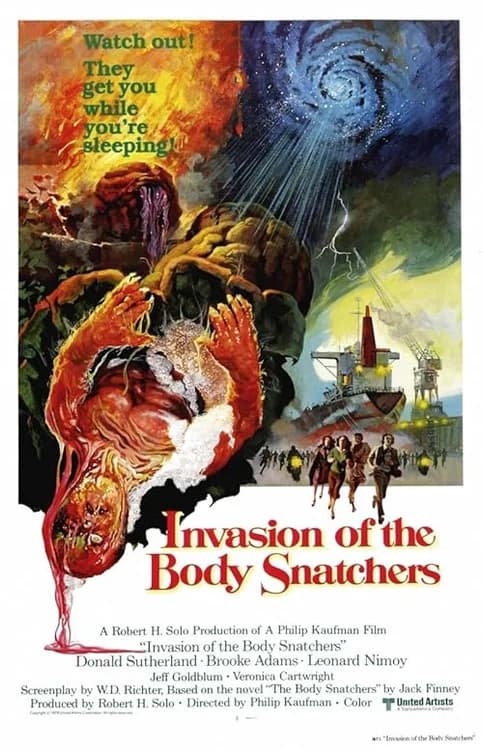
Donald Sutherland leads an exceptional cast in Philip Kaufman's masterful 1978 remake of Invasion of the Body Snatchers, a film that transcends its genre to become a chilling commentary on conformity and lost identity. Set against the foggy, atmospheric backdrop of San Francisco, the story follows health inspector Matthew Bennell as he discovers that strange alien pods are systematically replacing people with emotionless duplicates. The film builds dread with meticulous precision, transforming everyday urban spaces into landscapes of paranoia where you can no longer trust your closest friends or even your own senses.
The performances are uniformly superb, with Sutherland embodying weary determination and Brooke Adams, Veronica Cartwright, and Jeff Goldblum providing crucial emotional anchors as the circle of trust rapidly shrinks. Leonard Nimoy is particularly effective as a pop psychologist whose rational explanations become increasingly sinister. Kaufman's direction is taut and inventive, using sound design, subtle visual cues, and that now-iconic, unsettling pod-creation process to generate profound psychological horror rather than relying on graphic violence.
What makes this film essential viewing is how perfectly it captures the anxieties of its era while remaining timeless. The horror doesn't come from monsters but from the slow erosion of humanity, the quiet horror of seeing loved ones become hollow shells. Its infamous final scene remains one of cinema's most devastating moments. For anyone who appreciates smart, character-driven horror that lingers long after the credits roll, Invasion of the Body Snatchers is a masterpiece of sustained tension and thematic depth that demands to be watched and discussed.
The performances are uniformly superb, with Sutherland embodying weary determination and Brooke Adams, Veronica Cartwright, and Jeff Goldblum providing crucial emotional anchors as the circle of trust rapidly shrinks. Leonard Nimoy is particularly effective as a pop psychologist whose rational explanations become increasingly sinister. Kaufman's direction is taut and inventive, using sound design, subtle visual cues, and that now-iconic, unsettling pod-creation process to generate profound psychological horror rather than relying on graphic violence.
What makes this film essential viewing is how perfectly it captures the anxieties of its era while remaining timeless. The horror doesn't come from monsters but from the slow erosion of humanity, the quiet horror of seeing loved ones become hollow shells. Its infamous final scene remains one of cinema's most devastating moments. For anyone who appreciates smart, character-driven horror that lingers long after the credits roll, Invasion of the Body Snatchers is a masterpiece of sustained tension and thematic depth that demands to be watched and discussed.